
Google’s AI Search Guidance: What Business Owners Need to Know About SEO Now
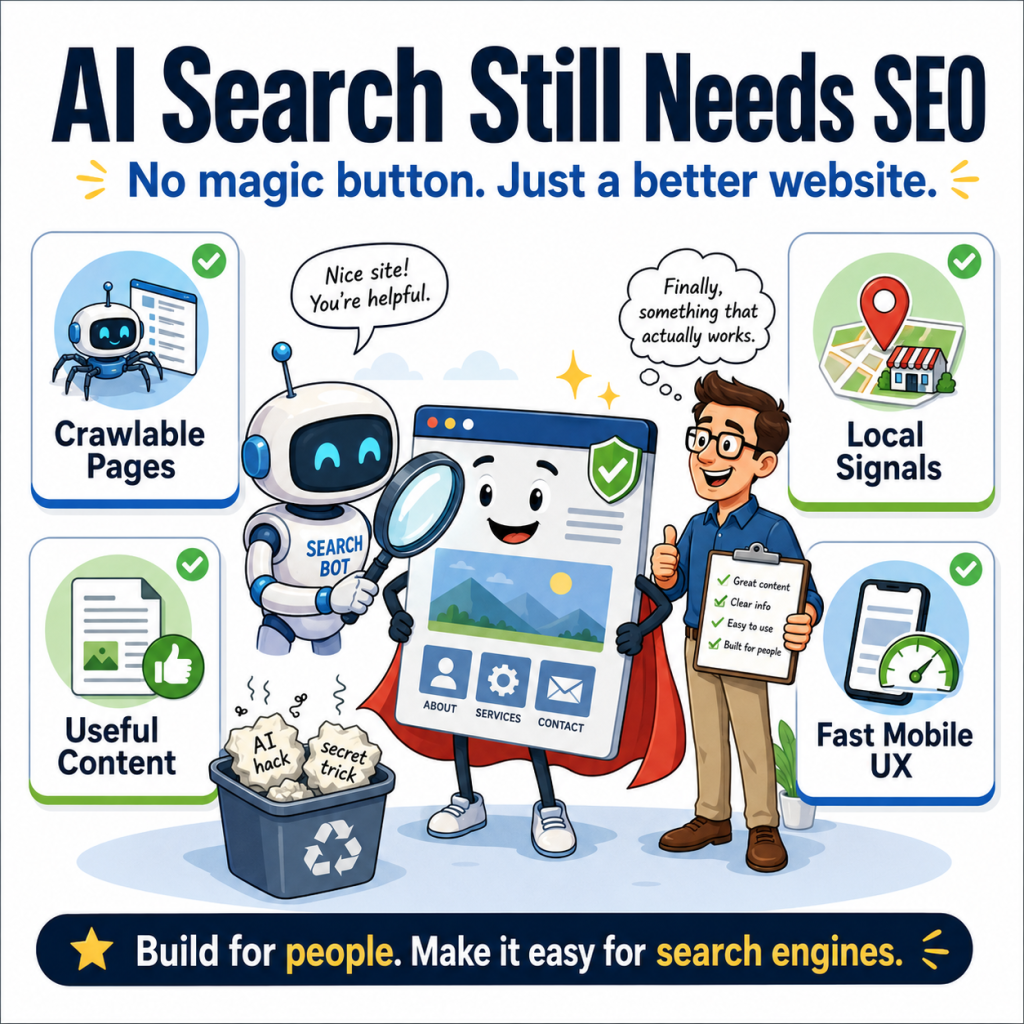
Google has published new guidance for website owners on how to optimize for generative AI features in Search, including AI Overviews and AI Mode.
For business owners, the headline is simple: SEO is still very much alive.
In fact, Google’s guidance makes the opposite point of what many people assume. AI-powered search does not mean businesses should abandon traditional SEO. It means the quality of your website, your content, and your technical structure may matter even more.
What Changed?
Google’s search experience is becoming more AI-driven. Instead of only showing a list of blue links, Google can now generate AI-powered responses, pull information from multiple sources, and help users explore more complex questions.
At Google I/O 2026, Google described this as a major evolution of Search, with AI Mode and agent-style features becoming a bigger part of how people find information.
That shift has understandably made business owners nervous.
If Google gives people answers directly, will they still visit websites?
If AI summarizes information, does SEO still matter?
According to Google’s own guidance, the answer is yes. Google says its generative AI features are still rooted in its core Search ranking and quality systems. In plain English: if your site is not strong enough for regular search, it is unlikely to magically perform well in AI search.
Why This Matters for Business Owners
Search behavior is changing.
Your potential customers are asking longer, more specific, more conversational questions. They are not always searching for a generic keyword. They may be asking for recommendations, comparisons, local options, service details, pricing expectations, or step-by-step help.
That creates a major opportunity for businesses with useful websites.
A strong website gives Google more reliable information to understand who you serve, what you offer, where you operate, and why someone should trust you.
A weak website does the opposite.
If your pages are thin, vague, slow, outdated, or hard to navigate, AI-powered search has less reason to surface your business as a helpful result.
What Google Says Businesses Should Focus On
Google’s guidance emphasizes several practical areas.
First, create valuable, original content. That means your website should not just repeat the same generic service descriptions every competitor uses. It should answer real customer questions, explain your process, show your expertise, and make your value clear.
Second, make sure your website can be crawled and indexed. If Google cannot access your pages properly, your content has little chance of appearing in regular search or AI-powered search features.
Third, strengthen your technical SEO. Clear page structure, internal links, schema markup, fast loading times, and mobile usability all help search engines understand and trust your site.
Fourth, use local and product signals where relevant. For local businesses, that means your Google Business Profile, service area information, reviews, location pages, and business details should be accurate and consistent. For ecommerce businesses, product feeds and structured product data can help Google understand what you sell.
Fifth, avoid chasing gimmicks. Google specifically warns against treating “AEO” or “GEO” as a separate bag of tricks. For Google Search, optimizing for AI search is still fundamentally SEO.
What This Could Look Like in Practice
Imagine a local HVAC company.
A weak website might have one service page that says, “We offer heating and cooling services. Contact us today.”
A stronger website would have clear pages for emergency repairs, AC installation, furnace replacement, maintenance plans, service areas, financing options, customer FAQs, reviews, and helpful articles about common problems.
That second website gives both people and search engines more useful information.
Now imagine someone searches, “Who can replace an AC unit near me quickly and explain financing options?”
The business with detailed, well-structured, helpful content is in a much better position than the business with a thin brochure-style website.
Practical Next Steps
Business owners should not panic about AI search. But they should take it seriously.
Start by reviewing your most important service or product pages. Do they clearly explain what you offer, who it is for, where you provide it, and what makes your business credible?
Check whether your website is fast and mobile-friendly. A site that loads slowly or feels awkward on a phone can lose both visitors and search visibility.
Look at your content from the customer’s point of view. Are you answering the questions people ask before they buy, book, call, or request a quote?
Review your local SEO basics. Make sure your Google Business Profile, website contact details, service areas, and reviews all support the same story.
Finally, stop treating SEO as a one-time setup. As search becomes more AI-driven, websites need to be maintained, improved, and expanded over time.
The Bottom Line
Google’s AI search update is not a reason to ignore SEO.
It is a reason to get serious about it.
Businesses that invest in clear website structure, useful content, technical performance, and local visibility will be better positioned as search continues to evolve.
The goal is not to trick AI.
The goal is to become the most useful, trustworthy answer for the customers you want to reach.
Sources:
https://developers.google.com/search/blog/2026/05/a-new-resource-for-optimizing
https://developers.google.com/search/docs/fundamentals/ai-optimization-guide
https://blog.google/products-and-platforms/products/search/search-io-2026/