
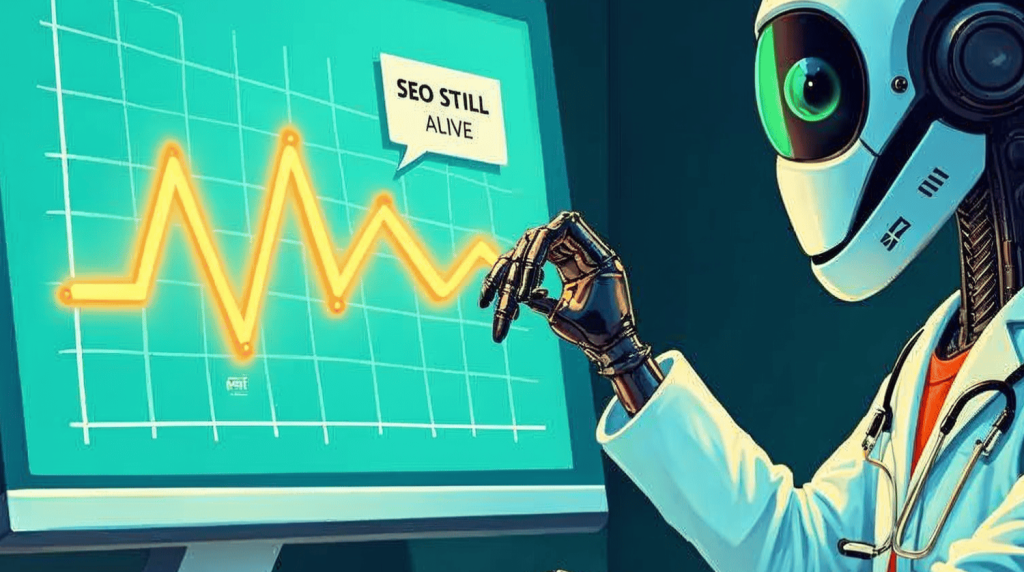
Every time something new happens in tech, someone declares SEO dead.
Social media was supposed to kill it. Voice search was supposed to kill it. Zero-click searches were supposed to kill it.
Now it’s AI.
You’ve probably seen the posts: “SEO is dead because of ChatGPT.” “Google traffic is going away.” “AI will replace content writers, agencies, and SEO experts.”
It sounds convincing at first, especially if you only think of SEO as writing blog posts.
But then you see something funny.
Anthropic, one of the leading AI companies in the world, is hiring an SEO Lead.
Anthropic is the company behind Claude. They are not outside the AI wave. They are helping build it.
And they still want someone to lead organic search.
That should make business owners pause for a minute.
If AI is supposed to replace SEO, why would one of the biggest AI companies need an SEO expert?
Anthropic’s job post says a lot about where SEO is going
This is not a basic content role.
Anthropic’s job posting says their SEO Lead will own organic search strategy across their web properties, including:
- claude.ai
- docs.anthropic.com
- anthropic.com
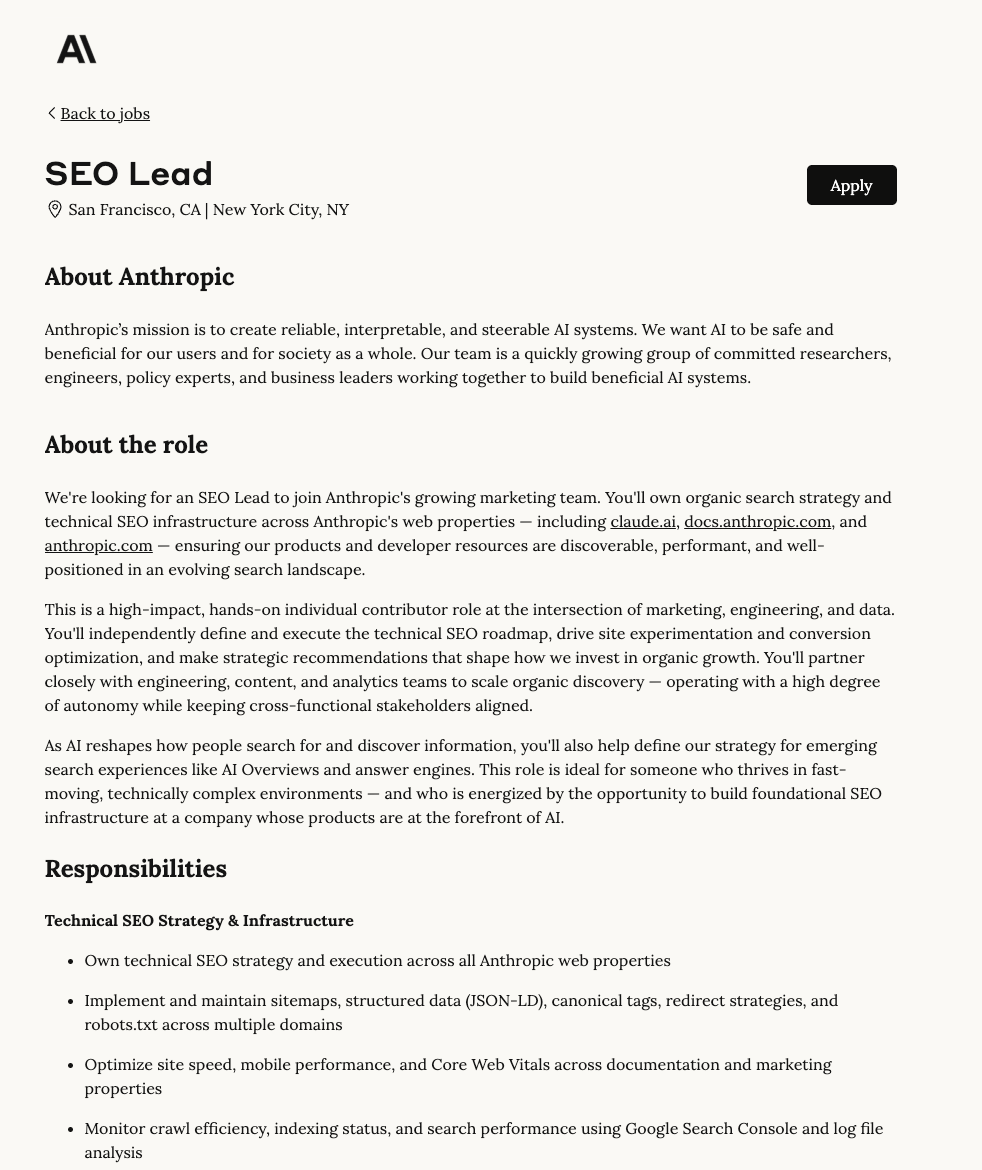
Source: https://job-boards.greenhouse.io/anthropic/jobs/5102291008
The role covers technical SEO, content strategy, documentation, analytics, experimentation, conversion optimization, and search experiences shaped by AI, including AI Overviews and answer engines.
That’s a serious SEO role.
They are looking for someone who understands how websites get discovered, how search engines understand content, how technical infrastructure affects visibility, and how organic traffic turns into business growth.
In other words, Anthropic is not treating SEO like a dying channel.
They are treating it like an important part of growth in the AI era.
The real problem is that many people misunderstand SEO
A lot of the “SEO is dead” conversation comes from a narrow view of what SEO actually is.
If SEO means “write 500 generic blog posts and stuff keywords into them,” then yes, that kind of SEO deserves to die.
AI has made generic content cheap. Anyone can create a passable article in a few seconds now. That means average content is no longer enough.
But real SEO was never just about publishing words.
Good SEO includes:
- understanding what customers are searching for
- building pages that match search intent
- fixing technical issues that stop pages from ranking
- improving site speed and user experience
- organizing content so Google can understand the site
- building authority and trust
- tracking what brings leads, not just traffic
- improving conversion paths after someone lands on the site
AI can help with parts of that work.
It can speed up research. It can help create outlines. It can draft meta descriptions. It can group keywords. It can summarize data.
But it still needs direction.
A hammer can help build a house. It does not replace the builder.
AI will make good SEO experts more efficient
We use AI in SEO work. It would be silly not to.
AI can save hours when used properly. It can help analyze large keyword lists, suggest content angles, clean up messy drafts, compare competitors, and speed up technical research.
But the value is not in pushing a button.
The value is knowing what to ask, what to ignore, what to verify, and what to do next.
That’s where SEO experts still matter.
For example, AI might suggest 50 blog topics. An SEO expert has to decide which topics are worth targeting, which ones support actual services, which ones are too competitive, and which ones are likely to bring the wrong traffic.
AI might draft an article. An SEO expert has to check if it matches the search intent, adds anything useful, supports the buyer journey, and deserves to rank against the pages already on Google.
AI might recommend schema markup. An SEO expert has to know whether that markup is appropriate, whether the page should be indexed, and whether the bigger issue is actually crawlability, duplicate content, or poor internal linking.
AI can make SEO faster.
It does not automatically make SEO smarter.
See how our SEO specialists in the Philippines handle keyword research, technical reviews and implementation for local and overseas businesses.
Search is changing, but people still need to find you
The way people search is changing. No question.
Some people still search on Google. Some ask ChatGPT. Some use Claude. Some read AI Overviews. Some search YouTube, Reddit, LinkedIn, TikTok, review sites, directories, and local map results before making a decision.
But the business problem has not changed.
Your ideal customer still has questions.
They still compare options.
They still look for proof.
They still need to trust you before they contact you.
SEO is about showing up during that discovery process.
The places where people discover information may expand, but discoverability is not going away. If anything, it is getting more competitive because there is now more content, more noise, and more automated answers between you and your customer.
That means your website, content, brand mentions, technical setup, and authority signals matter even more.
The future of SEO is more strategic, not less
The SEO work that survives AI will be more strategic.
It will be less about “Can we publish another article?” and more about better questions:
- Which pages actually drive leads?
- Which topics support our services?
- Which pages should be updated, merged, redirected, or removed?
- Are we showing up in AI-generated answers?
- Does our content demonstrate real expertise?
- Is our website technically clean?
- Are our service pages strong enough to convert?
- Are we earning trust outside our own website?
This is why the Anthropic job post is so interesting.
Their SEO Lead is expected to work across marketing, engineering, data, documentation, and experimentation. That is where SEO is headed for many businesses.
Not just content.
Not just rankings.
A full organic growth system.
What business owners should take from this
If you own a business, don’t panic every time someone says SEO is dead.
And don’t fall for the opposite mistake either, which is thinking you can replace a real SEO strategy with a pile of AI-written blog posts.
The businesses that win from here will use AI, but they will not let AI drive the whole strategy.
They will still need:
- clear service pages
- technically healthy websites
- content based on real customer questions
- strong local and industry signals
- helpful internal linking
- proof, reviews, case studies, and authority
- tracking that connects SEO to leads and revenue
AI can help you move faster on all of this.
But speed without direction just gets you lost faster.
SEO is not dead. Shallow SEO is.
Anthropic hiring an SEO Lead is a good reminder that search still matters, even to the companies building AI.
What is dying is lazy SEO.
Thin articles. Keyword stuffing. Publishing content just to publish content. Chasing traffic with no plan for leads. Copying competitors without understanding customers.
That version of SEO is getting weaker.
But good SEO is very much alive.
It is becoming more technical, more strategic, and more connected to the full customer journey.
AI will not replace SEO experts who know what they are doing.
It will make them more efficient.
And for businesses that take organic visibility seriously, that is good news.