
White-Label SEO Is Not Cutting Corners: It Is How Smart Agencies Scale
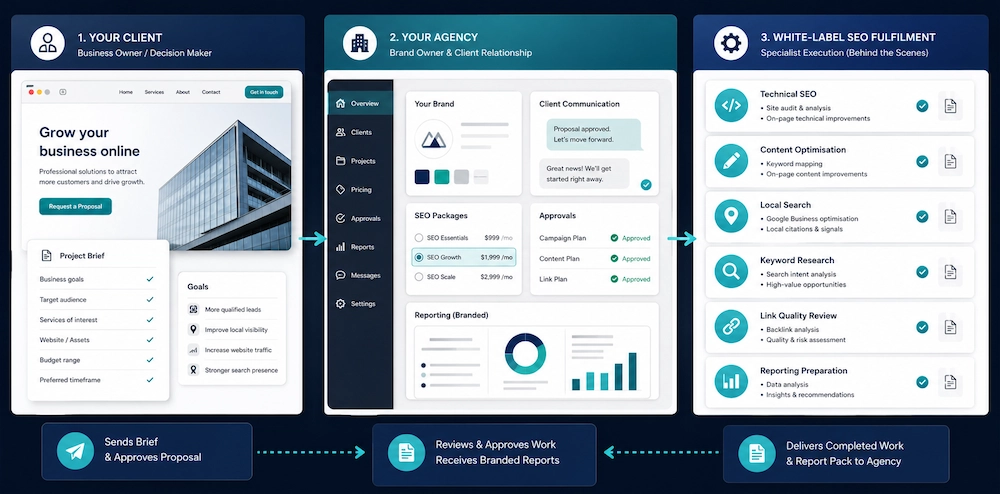
TLDR: White-label SEO helps agencies expand their services and delivery capacity by allowing a specialised external team to complete SEO work under the agency’s brand.
Key Takeaways
- Agencies keep control of client relationships, pricing, communication, and branding.
- Clear scopes, approval processes, and quality standards prevent fulfilment problems.
- Outsourced support can provide access to technical, content, local, and off-page SEO expertise.
- The right provider should operate like a dependable extension of the agency’s internal team.
Winning a new SEO client often creates delivery challenges as agencies juggle multiple tasks. Hiring in-house can be costly and slow, which is why white-label SEO has become a practical way to expand capacity without building a full team.
Under this arrangement, an agency sells SEO under its own brand while a specialised provider handles the work behind the scenes. This setup works best when everyone agrees from the start on responsibilities, quality standards, and how communication will be handled.
Your Agency, Front and Center
White-label SEO lets an agency offer SEO under its own brand while a provider does the work behind the scenes. The client deals only with the agency, which manages the relationship and presents results.
Unlike referrals, white-label fulfilment keeps the agency in control. It also differs from hiring freelancers, as a structured provider follows consistent systems for planning, execution, and reporting.
Agency Control Stays Yours
Outsourcing the work does not require an agency to give up its brand or client relationships. The agency can still decide:
- Which services to sell
- How packages are priced
- How strategies are presented
- Which recommendations require approval
- How often clients receive updates
The provider supports delivery, but the agency remains accountable for the promises made to the client.
Start Strong Before Keywords
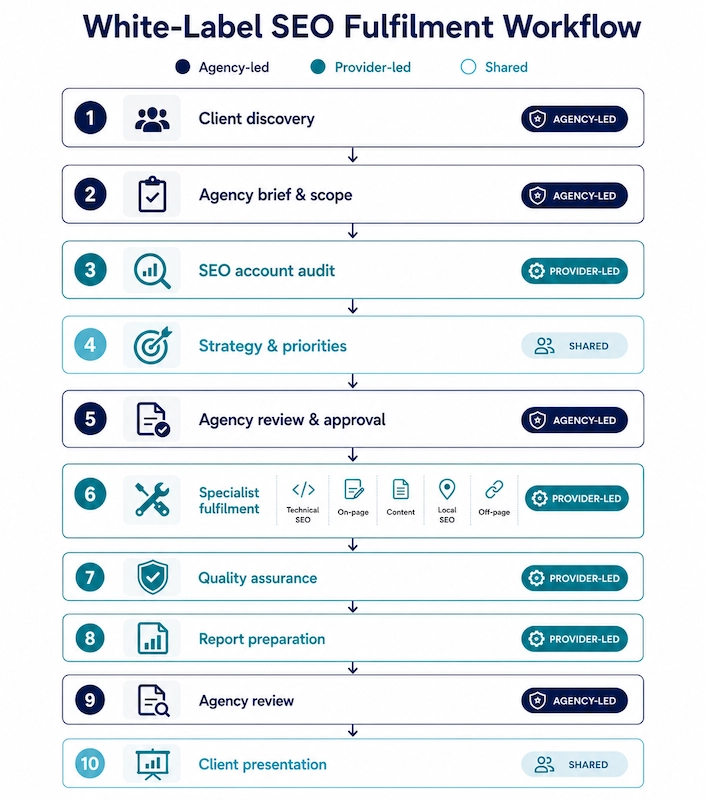
A strong SEO campaign begins by understanding the client’s business and goals. The agency gathers key details from the client, such as services, target audience, competitors, and access to essential data.
Once the information is in place, the fulfilment provider reviews the account to spot opportunities and issues. This review may include technical performance, rankings, content, backlinks, local visibility, competitors, and conversions.
Define the Scope Clearly
“Handle our SEO” is too vague, so both sides should agree upfront on the exact services included. The agreement should define deliverables, timelines, revisions, access, and approvals so both sides know what to expect.
Strategy Should Be Clear, Not Hidden
After reviewing the account, the fulfilment team recommends a campaign plan based on the client’s position and goals. Priorities may include fixing technical issues, improving pages and listings, strengthening internal links, or aligning content with search intent.
Even if the provider handles research and recommendations, the agency should understand the reasoning behind them. A reliable partner should clearly explain why each task matters, what problem it solves, and how it supports the overall goal.
Approval Avoids Mistakes
Some agencies allow routine updates without approval, while others review every change, and both approaches can work if expectations are clear. Major decisions still need agency oversight to protect messaging, pricing, and branding.
SEO Work, Split Smart
One reason agencies use white-label fulfilment is that SEO requires multiple skills. Building all of that expertise in-house can be challenging, especially when client demand shifts from month to month.
Strong Technical SEO Foundation
Technical work improves how search engines access and index a site by fixing structure, links, tags, speed, and indexing issues. A good report highlights key issues and separates urgent problems from minor ones.
Match Pages to Search Intent
On-page work clarifies each page’s purpose with keywords, titles, headings, links, and intent-focused content. Agencies should expect recommendations that balance rankings with user experience.
Turning Strategy into Pages
White-label content support includes blogs, pages, briefs, and updates, but it needs a clear understanding of the client to avoid generic output. Agencies should decide who checks facts before publishing.
Boost Local Visibility
For businesses that rely on nearby customers, fulfilment may include local keyword research, business profile optimisation, and location pages. This work should match real service areas and provide useful, relevant information for each location.
Off-Page SEO Demands Quality
Some providers handle link building and PR, so agencies should understand how opportunities are evaluated. Relevance and quality matter more than volume, and cheap bulk links often indicate low-quality methods that can harm reputation.
White-Label Reports Should Explain Progress, Not Hide Behind Data
Reporting is a key part of outsourced fulfilment, and providers often supply unbranded reports for agencies to present as their own. A good report highlights completed tasks, ranking changes, traffic, conversions, and key priorities for the next period.
However, more data does not always make a report better because clients need clear context to understand what it means. It should show where traffic growth came from and whether it led to enquiries, bookings, or calls.
You Own the Story
Even if the provider prepares the report, the agency should review it before sending. The report should match the strategy, explain any changes, and the agency remains responsible for clear communication.
Communication Makes or Breaks It
White-label providers usually communicate only with the agency, which then handles all client interactions. This gives the agency full control, though it requires the team to clearly understand and explain the campaign.
Some providers may join calls as specialists or use agency-branded channels. Agree on clear communication rules early so everyone knows who responds, response times, and if direct client contact is allowed.
Responsibility Remains
White-label SEO can ease your workload, but it doesn’t make your agency a passive middleman. You still need to win the right clients, gather key information, set clear expectations, review work, and manage the relationship.
This matters even more when clients expect quick results, since SEO takes time to show real impact. A fulfilment partner can expand your capacity, but it can’t fix weak sales promises, unclear agreements, or poor account management.
Scale First, Hire Later
Hiring internally gives an agency direct control, but it also creates fixed costs that continue even when demand slows. Salaries, recruitment, software, training, and benefits can quickly add up and limit flexibility.
White-label fulfilment turns some of those fixed expenses into flexible costs, allowing agencies to scale without immediate hiring. It also gives access to more SEO skills, helping agencies expand services without overloading their team.
Cheap SEO Can Cost You More
White-label SEO is not always dependable. Weak partnerships can cause delays, low-quality work, and unhappy clients. While outsourcing may cut costs, it can cost more if it damages trust or retention.
Red flags include guaranteed rankings, unclear links, generic advice, activity-heavy reports without strategy, and poor communication. A reliable partner should be transparent about processes, timelines, and limits, and back claims with clear reasoning.
Choose an In-House-Like Partner
Before choosing a provider, confirm account management, review processes, and sample work to assess quality. Useful questions include:
- How do you determine campaign priorities?
- Who reviews technical recommendations and content?
- What information do you need during onboarding?
- How often will we receive updates?
- Can reports carry our branding?
- How do you assess backlink quality?
The best relationship should feel like part of the agency, with clear processes, reliable communication, and shared standards.
Keyforge SEO Helps Agencies Expand
Keyforge SEO offers SEO outsourcing and white-label fulfilment for agencies needing extra capacity without losing control of their brand or client relationships. Its services can support areas such as content optimisation, link building, broader SEO execution, and white-labelled reporting.
Based in the Philippines, the company provides experienced, cost-effective SEO support focused on practical strategies that drive measurable growth. This partnership helps agencies take on more clients without costly hiring.
Grow SEO Clients Easily
Winning more work should help your agency grow, not leave your team struggling to meet deadlines. Keyforge SEO supports your agency behind the scenes with white-label SEO services that fit your brand, starting with a clear conversation about your services, standards, and capacity.
Contact Keyforge SEO now!