
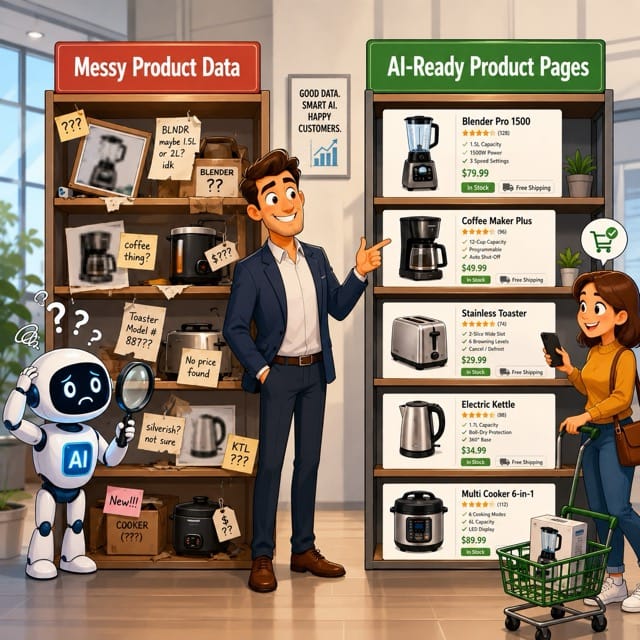
Google is piloting a new AI performance insights report inside Merchant Center, and it gives business owners a useful preview of where search visibility is heading.
The report is built for Google’s AI shopping experiences, including AI Mode and AI Overviews. According to Google, it helps merchants see how their brands show up in conversational shopping results, evaluate visibility across the shopping journey, and find trends that can improve product data.
That is a big shift.
For years, ecommerce SEO focused heavily on rankings, product pages, category pages, schema markup, and product feeds. Those pieces still matter. Now they are also part of how AI systems decide whether a product is clear enough, complete enough, and trustworthy enough to include in an answer.
What changed
Google’s AI performance insights report is currently in a limited U.S. pilot for select Merchant Center accounts. Google says it will expand more broadly to Australia, Canada, India, and New Zealand in the coming months.
The report includes metrics and filters such as:
- Share of voice for your brand or product
- Competitor average share
- Query frequency
- Query type
- Product category
- Time period
- Country
- Organic AI traffic from AI experiences
Google also says the report focuses on conversational shopping queries, mainly shopping-intent and brand-related searches.
That matters because shoppers are not only typing short keywords anymore. They may ask longer questions like:
“Best waterproof trail shoes for wide feet under $150”
“Comfortable office chair with lumbar support and fast shipping”
“Which cordless drill is good for beginners and small home projects?”
Those searches depend on detailed product information. If your product feed or product page does not include the right attributes, your product may not be easy for AI systems to evaluate.
Why this matters for business owners
AI shopping visibility starts before the click.
A shopper may never land on your website if Google’s AI cannot understand your product well enough to include it in a comparison, recommendation, or buying path.
This makes product data a business issue, not just a technical SEO task.
Incomplete product pages can create several problems:
- AI systems may not match your products to relevant shopping questions.
- Customers may see competitors with clearer specs, pricing, or availability.
- Missing shipping, return, or inventory details can reduce trust.
- Weak product structure can make comparison shopping harder.
- Poor page design can lose the sale even if the click arrives.
A clean ecommerce website gives both humans and AI systems fewer reasons to hesitate.
What to check now
Start with your most important products and categories.
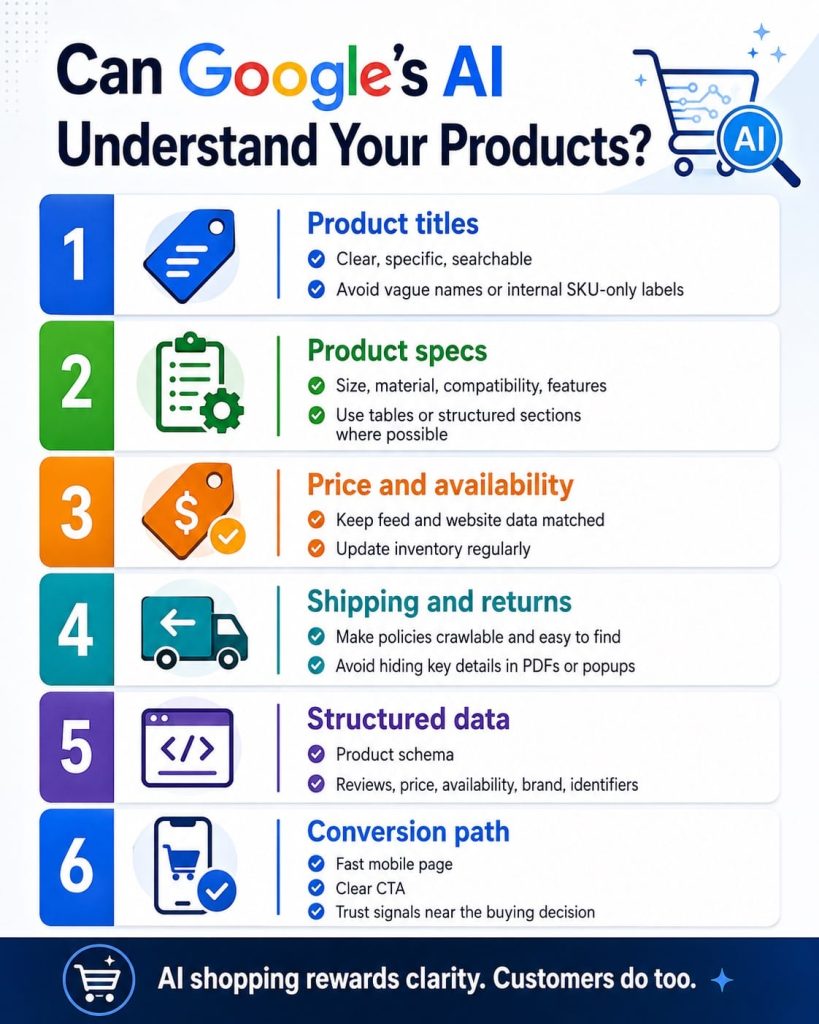
Check whether each product page has a clear title, useful description, current price, availability, shipping details, return information, strong images, product specs, and customer proof where relevant.
Then look at the structure of the page. Important details should be visible in crawlable HTML, not locked inside awkward tabs, PDFs, scripts, or design elements that are hard for search systems to parse.
Product schema also deserves attention. Structured data helps search engines understand price, availability, reviews, brand, product identifiers, and other key details. It does not fix a weak page by itself, but it can support a cleaner information layer.
Finally, review your Merchant Center feed. Product attributes, categories, pricing, inventory, and identifiers should match what customers see on the website. If your feed says one thing and your page says another, that inconsistency can hurt trust.
How this connects to web design and conversion
AI shopping visibility is not separate from website quality.
A better product page helps in several ways at once. It gives Google clearer information. It gives customers better answers. It reduces buying friction. It improves trust after the click.
Strong ecommerce design should make product comparison easy. Specs should be scannable. Calls to action should be obvious. Reviews should be easy to find. Shipping and returns should not feel hidden. Mobile pages should load quickly and make checkout feel simple.
The businesses that benefit from AI shopping will likely be the ones with clean product data, strong technical SEO, clear page design, and a website experience that helps customers make decisions quickly.
Google’s new report is a reminder that messy product information is becoming more expensive.
If your products deserve to be recommended, your website needs to make that easy to understand.