
Google Searches Are Becoming Click-Shy: What Business Owners Should Do Now
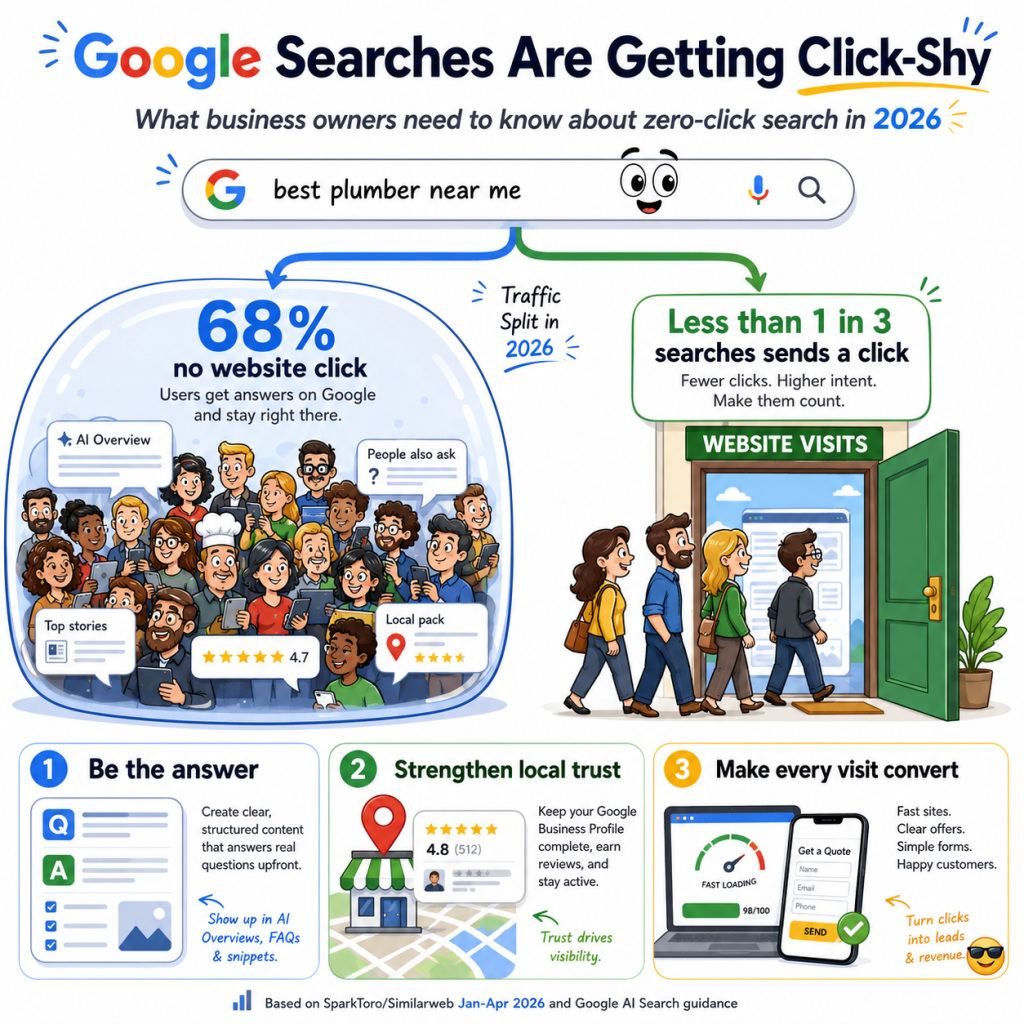
Google search is changing quickly, and the latest data makes one thing clear: getting found online is no longer just about earning a ranking and waiting for clicks.
A June 2026 SparkToro study using Similarweb clickstream data found that 68.01% of U.S. Google searches ended without a click during the first four months of 2026. In plain language, more than two out of three searches did not send a visitor to a website.
That does not mean your website no longer matters. It means your website, SEO, local presence, and brand signals need to work harder together.
What Changed
Google has been steadily adding more ways for searchers to get answers directly inside the search results page. These include AI Overviews, AI Mode, featured snippets, local map results, business profiles, product information, videos, and follow-up search prompts.
Google’s own Search Central guidance says AI Overviews and AI Mode can show supporting links from indexed web pages, and that the same SEO fundamentals still apply: crawlable pages, helpful content, strong internal linking, good page experience, accurate structured data, and up-to-date Business Profile information.
So the shift is not “SEO is over.”
The shift is this: SEO is no longer only about traffic volume. It is also about visibility, trust, answer quality, and conversion readiness.
Why This Matters For Business Owners
For years, many businesses judged SEO success mainly by traffic. More impressions, more clicks, more sessions.
That is still useful, but it is no longer enough.
If Google answers more questions before the visitor reaches your site, then your business has to win in two places:
First, you need to be visible where answers are being formed.
Second, when someone does click, your website needs to turn that visit into action.
This makes your website more important, not less. A slow, vague, outdated, or confusing site has less room for error now. If fewer clicks are available, every qualified visitor is more valuable.
What This Could Mean In Practice
A local service business may still appear in search, but customers might compare options directly from Google’s map pack, reviews, summaries, and AI-generated results before clicking.
A professional service firm may have helpful blog posts, but if the content is too generic, Google may summarize better answers from competitors.
An ecommerce or lead generation site may still get high-intent visitors, but if the page loads slowly, lacks trust signals, or hides the next step, those clicks are wasted.
The businesses best positioned for this environment are the ones with clear service pages, useful answer-based content, strong local signals, good reviews, fast performance, and simple conversion paths.
Practical Next Steps
Start by reviewing your most important service pages. Do they clearly explain what you offer, who it is for, where you serve, why someone should trust you, and what they should do next?
Next, check whether your site answers the real questions customers ask before buying. Pricing, process, timelines, comparisons, common problems, service areas, and proof of results all matter.
Then look at your local SEO basics. Your Google Business Profile, reviews, categories, photos, services, and contact details should be accurate and consistent.
Finally, evaluate your website experience. A site that is slow on mobile, hard to navigate, or vague above the fold is going to struggle in a lower-click search environment.
The Bottom Line
Zero-click search does not remove the need for SEO. It raises the standard.
Your business needs to show up with useful, trustworthy information before the click, then deliver a clean, persuasive website experience after the click.
The goal is no longer just more traffic.
The goal is better visibility, better trust, and better conversion from the traffic that still reaches you.