
What Happens During a Professional SEO Audit?
TL;DR: A professional SEO audit gives you a clear view of why your website is not performing as well as it should. It helps you focus on fixes that can improve visibility, traffic, and leads instead of wasting time on random SEO tasks.
Key Takeaways
- An SEO audit checks more than rankings, including technical setup, content quality, local visibility, backlinks, user experience, and tracking.
- The best audits connect SEO issues to business goals, so recommendations are based on leads, sales, and growth.
- A clear roadmap matters because not every SEO issue has the same level of urgency or impact.
- If your website traffic, rankings, or leads have stalled, an audit can show where the real problems are.
Your website may look clean and professional, but is it helping the right people find your business? That is what a professional SEO audit is meant to answer. It checks your website’s technical health, content, keywords, local visibility, backlinks, and ability to turn visitors into leads.
For many business owners, SEO feels like guesswork. You update pages, publish blogs, or pay for marketing, yet competitors still show up above you on Google. A good SEO audit replaces guessing with a clear list of what is working, what is broken, and what needs attention first.
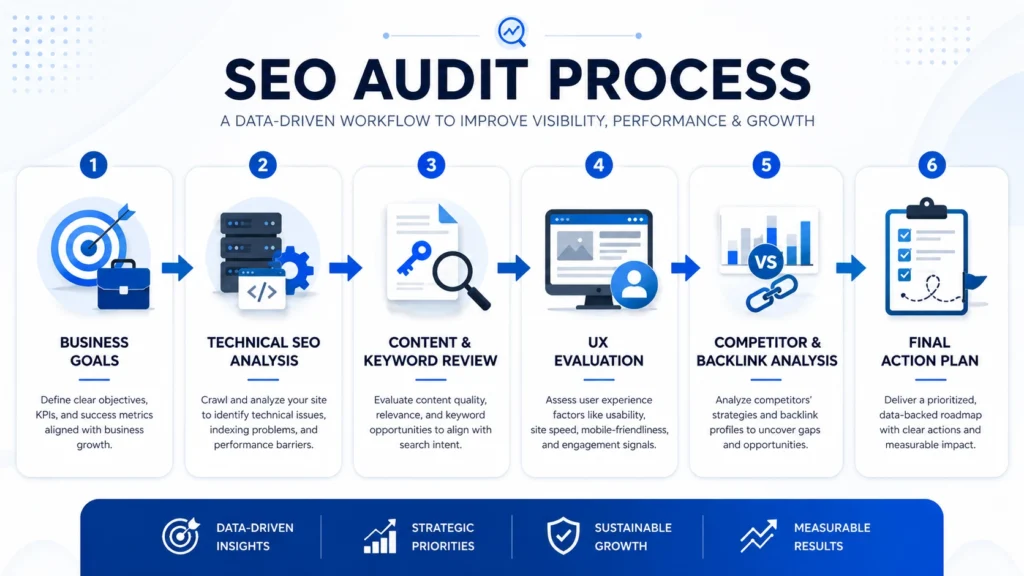
The Audit Starts With Your Business Goals
A proper SEO audit should not begin with a tool. It should begin with your business, your customers, and the kind of leads you actually want. The SEO team needs to know what you sell, where you operate, who you serve, and which services matter most to revenue. SEO for a local dentist is not the same as SEO for an eCommerce store, agency, contractor, or nationwide brand.
Technical SEO Shows What Search Engines Cannot Read
Technical SEO sounds complex, but the main idea is simple. Search engines need to crawl, read, and index your pages before they can rank them. During this part of the audit, the specialist checks for crawl errors, broken links, redirect issues, duplicate pages, slow speed, mobile problems, poor URL structure, missing sitemaps, blocked pages, and schema errors.
Why Indexing Matters
Indexing tells you whether Google has stored a page in its search results. If an important service page is not indexed, it has little chance of bringing in organic traffic.
During this check, the audit reviews:
- Google Search Console coverage data
- XML sitemap status
- Canonical tags
- Noindex tags
- Crawl depth
- Internal links to important pages
These checks confirm whether your most important pages can actually be found.
Keyword and Search Intent Review Finds Better Opportunities
Keywords still matter, but stuffing keywords into a page is not SEO. A strong audit looks at what people search for and why they search for it. Someone searching “what is SEO” is probably still learning. Someone searching “professional SEO audit service” is much closer to contacting a provider.
That difference is search intent. Your pages need to match the intent behind the keyword, or they may attract traffic that never turns into inquiries. The audit checks current rankings, missed keyword opportunities, weak page targeting, and keyword cannibalization. Cannibalization happens when two or more of your pages compete for the same search term.
What On-Page SEO Reveals
On-page SEO reviews the page elements that help search engines and readers understand what the page is about.
This usually includes:
- Title tags
- Meta descriptions
- Headings
- Page copy
- Image alt text
- Internal links
- Calls to action
- Page structure
A service page should not just mention the service name. It should clearly explain:
- Who the service is for
- What problem it solves
- What is included
- Why the visitor should trust your business
Content Review Finds Pages Worth Fixing
Content can help your website rank, but only when it answers real questions and supports a clear next step. Publishing more pages will not help much if the content is thin, outdated, or written for keywords instead of people.
A professional audit reviews your service pages, landing pages, blog posts, guides, and other key content to see what should stay, what needs work, and what should be rebuilt. The goal is simple: make your content more useful for buyers and easier for them to move toward a consultation, service page, audit request, or contact form.
Local SEO Checks Help Nearby Customers Find You
If your business serves a specific city, region, or service area, local SEO deserves a closer look. Showing up on Google Maps can matter just as much as ranking on regular search results, especially when people nearby are ready to call, visit, or book.
A local SEO audit checks your Google Business Profile, service areas, reviews, photos, business hours, website links, and local search visibility. It also reviews whether your name, address, and phone number are consistent across directories, because mismatched details can make your business look less reliable to both customers and search engines.
Competitor and Backlink Review Shows the Real Playing Field
SEO is competitive. Your website is not judged alone, but against the other pages trying to rank for the same searches. A professional audit studies the websites already ranking for your target keywords. The team checks their content, page structure, backlinks, internal links, local presence, and how well they match search intent.
This helps show whether you need better content, stronger service pages, more authority, faster pages, improved local SEO, or a mix of several fixes. Backlinks are also reviewed because they act as trust signals. The audit looks for strong links, weak links, suspicious patterns, lost links, anchor text issues, and authority gaps.
User Experience Checks Turn Rankings Into Leads
Traffic is useful only when visitors take action. Your website should make it easy for people to understand your offer, trust your business, and contact you. This part of the audit reviews navigation, mobile layout, page speed, forms, calls to action, testimonials, service page clarity, contact details, and overall page flow.
Tracking Must Be Clean
Your tracking setup should show what is actually happening after people visit your website. Without clean data, it is hard to know which SEO efforts are bringing real leads and which ones only look good on paper.
A proper audit should check whether these are working correctly:
- Google Analytics
- Google Search Console
- Conversion tracking
- Form tracking
- Call tracking
- Contact button or click-to-call tracking
A Useful SEO Audit Ends With a Clear Action Plan
A professional SEO audit should not leave you with a giant report and no direction. It should tell you what to fix first, what can wait, and what is likely to create the most business impact.
Some fixes may be quick, such as updating titles or repairing broken links. Others may need planning, such as rewriting service pages, improving site speed, or building a stronger content strategy.
A clear roadmap helps you avoid wasting time on low-impact work. It also makes it easier to assign tasks to your developer, writer, SEO provider, or internal team.
Signs Your Website Needs an SEO Audit
You should consider an SEO audit if your traffic has dropped, rankings are stuck, leads have slowed down, or competitors keep outranking you. It is also useful after a redesign, migration, or major content update.
An audit is smart before hiring an SEO company, increasing your marketing budget, launching a new website, or expanding into a new location. It helps you find problems before they become more expensive to fix.
Why Choose KeyforgeSEO for a Professional SEO Audit?
At KeyforgeSEO, we help businesses figure out what is holding their websites back and what needs to be fixed first. As an SEO services company in the Philippines, we work with local and international clients that need practical, cost-effective help with technical SEO, local SEO, content, link building, Google Business Profile optimization, web design, and Google Ads.
That wider view matters because SEO problems usually do not come from just one issue. We look at the full picture, then give you clear recommendations that fit your business, market, and budget instead of handing you a generic checklist.
Book a Professional SEO Audit With KeyforgeSEO
If your website is not bringing the traffic or leads you expected, guessing is not a strategy. A professional SEO audit can show where your site is losing visibility and what to do next.
KeyforgeSEO can review your technical SEO, keyword targeting, content gaps, local SEO setup, backlinks, tracking, and conversion issues. From there, you get a practical action plan built around your goals.
Book your free website audit or contact KeyforgeSEO today.